Virtual Study Visit to Austria: Recognising Skills Beyond Formal Education
1/22/20268 min read


On 27–28 November 2025, the European Centre for Freedom and Independence (EUCFI) co-organised a two-day Virtual Study Visit to Austria dedicated to the recognition, validation and certification of skills acquired through non-formal learning, community work and volunteering. The event was implemented within the framework of the EU4Youth Phase III – Youth Employment and Entrepreneurship Programme, co-funded by the European Union and the Ministry of Foreign Affairs of the Republic of Lithuania, and implemented by the Central Project Management Agency (CPVA), with EUCFI acting as the Austrian co-organising partner.
The study visit brought together more than 80 representatives of public authorities, youth institutions, employment services, qualification bodies and civil society organisations from Eastern Partnership (EaP) countries and the European Union. Conducted online, the programme offered an in-depth exploration of Austria’s comprehensive approach to validating competences gained outside formal education and translating them into recognised and labour-market-relevant qualifications.
Why Austria? A Model for Validation and Trust
Across the Eastern Partnership region, large numbers of young people, volunteers and adult learners acquire valuable skills through youth work, civic engagement, volunteering and community initiatives. However, these competences often remain invisible in formal qualification systems and underutilised in the labour market. Austria stands out in Europe for its structured, legally grounded and cooperative approach to validation of non-formal and informal learning.
Rooted in a strong lifelong learning tradition, Austria’s model is supported by a clear legal framework, an established National Qualifications Framework (NQF), and close cooperation between ministries, social partners, public agencies and civil society. It demonstrates how education, youth policy and labour market systems can work together to make skills transparent, portable and widely recognised.
The Virtual Study Visit was designed to provide EaP stakeholders with concrete policy insights, institutional practices and practical tools that can inform evidence-based reforms in their own national contexts.
Opening the Dialogue: International and Government Focus
The first day of the study visit focused on international perspectives and governmental frameworks. Opening remarks were delivered by Austėja Vilkelytė, Programme Manager at CPVA, followed by an introduction to the objectives and expected outcomes of the study visit by Evgeniia Petrivska, International Key Expert of the EU4Youth Youth Employment and Entrepreneurship Programme.
Underlining the broader policy relevance of the topic, Evgeniia Petrivska emphasised the urgency of advancing validation systems across the region:
“Recognising skills gained beyond formal education is no longer optional – it is essential for building inclusive, future-ready labour markets. This online study visit demonstrated how cooperation between governments, civil society and social partners can turn non-formal learning and volunteering into meaningful opportunities for young people. We are pleased to see strong motivation among Eastern Partnership countries to continue advancing their validation systems.”
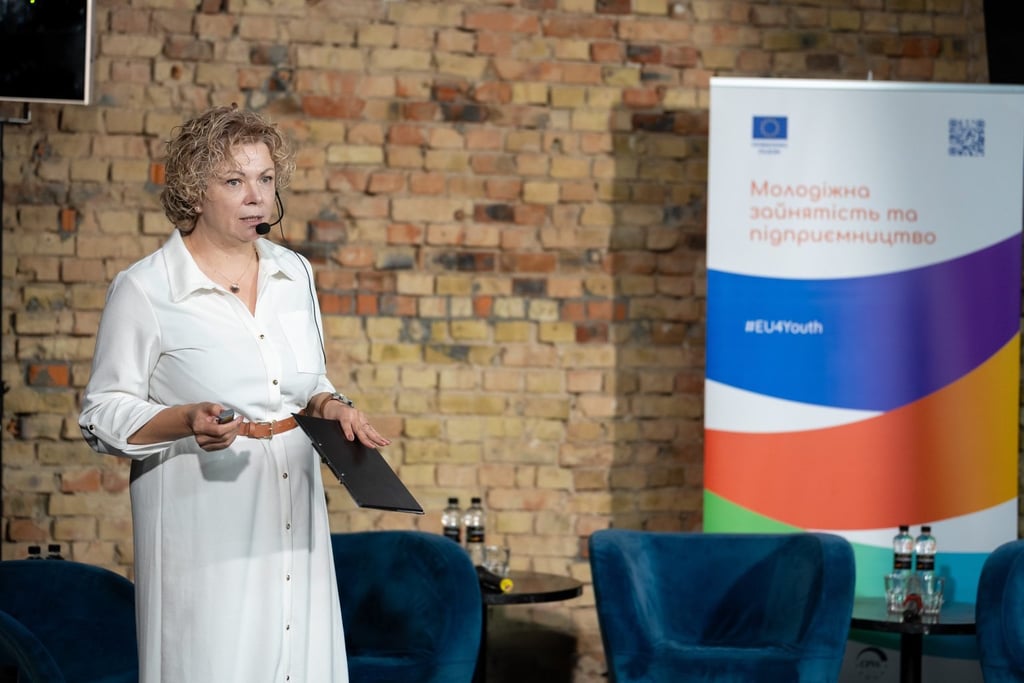

A keynote address by Maria Rosenstock from the European Training Foundation (ETF) placed the Austrian experience in a broader regional context, focusing on new routes to qualification and the relevance of validation systems for Eastern Partnership countries.
Day 1: International and Government Focus
The first day of the Virtual Study Visit was dedicated to international perspectives and governmental frameworks for recognising, validating and certifying skills acquired outside formal education. It opened with welcome remarks from Austėja Vilkelytė, Programme Manager at the Central Project Management Agency (CPVA, Lithuania), followed by an introduction to the objectives, partners and expected outcomes of the study visit by Evgeniia Petrivska, International Key Expert of the EU4Youth Youth Employment and Entrepreneurship Programme.
The international dimension was further strengthened by a keynote address from Maria Rosenstock of the European Training Foundation (ETF), who examined validation of non-formal and informal learning as new routes to qualification in Eastern Partnership countries and underlined its growing importance for inclusive labour markets.
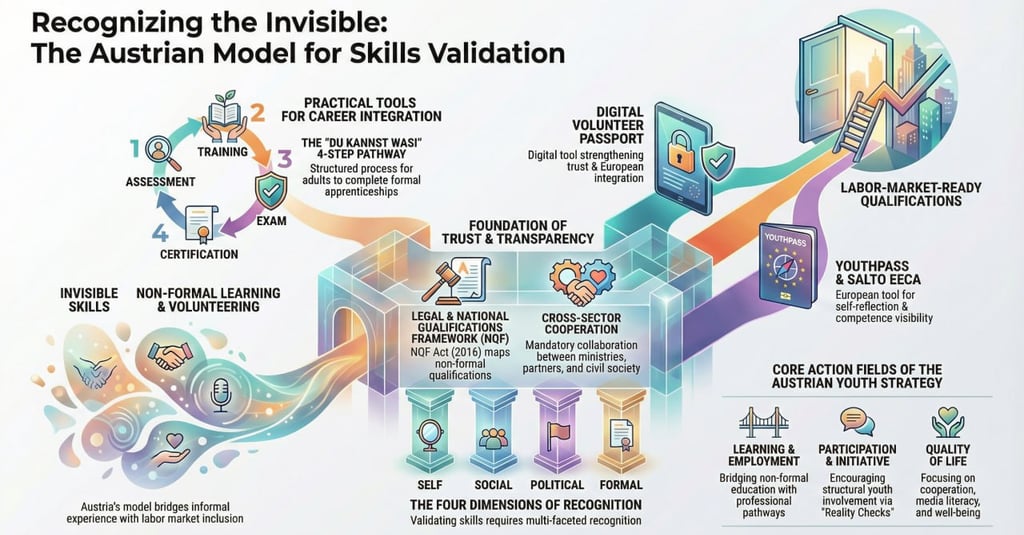
Subsequent sessions focused on Austria’s official strategies and instruments. The Federal Ministry of Economy, Energy and Tourism presented the Austrian dual vocational education and training (VET) system, with particular attention to mechanisms that allow skills gained through work experience to be formally recognised. These included exceptional admission to apprenticeship examinations and the “Du kannst was!” programme, a structured four-step pathway enabling adults with professional experience to complete an apprenticeship and obtain a recognised qualification.
An in-depth overview of the National Qualifications Framework (NQF) was provided by OeAD – Austria’s Agency for Education and Internationalisation. The presentation explained the legal basis of the NQF under the NQF Act (2016), its objectives of transparency and comparability, and the procedures for mapping both formal and non-formal qualifications to NQF and EQF levels through the publicly accessible NQF Register.
Innovative approaches to validation were then showcased by the Federal Ministry for Labour, Social Affairs, Health, Care and Consumer Protection together with the Austrian Institute of Technology (AIT). A key example was Austria’s Digital Volunteer Passport, presented as a tool to strengthen trust in spontaneous volunteers, particularly in crisis management contexts, and as a practical use case for the future European Digital Identity (EUDI) Wallet.
The day concluded with a practice-oriented perspective from WienXtra – Institut für Freizeitpädagogik, which presented its long-standing experience in recognising competences in youth work and leisure education. The session demonstrated how structured training offers, certification practices and cooperation with quality assurance bodies such as wien-cert and aufZAQ contribute to the professionalisation and recognition of youth work in Vienna. The programme closed with a summary and peer reflections facilitated by EUCFI, allowing participants to connect Austrian practices with reform needs in their own countries.
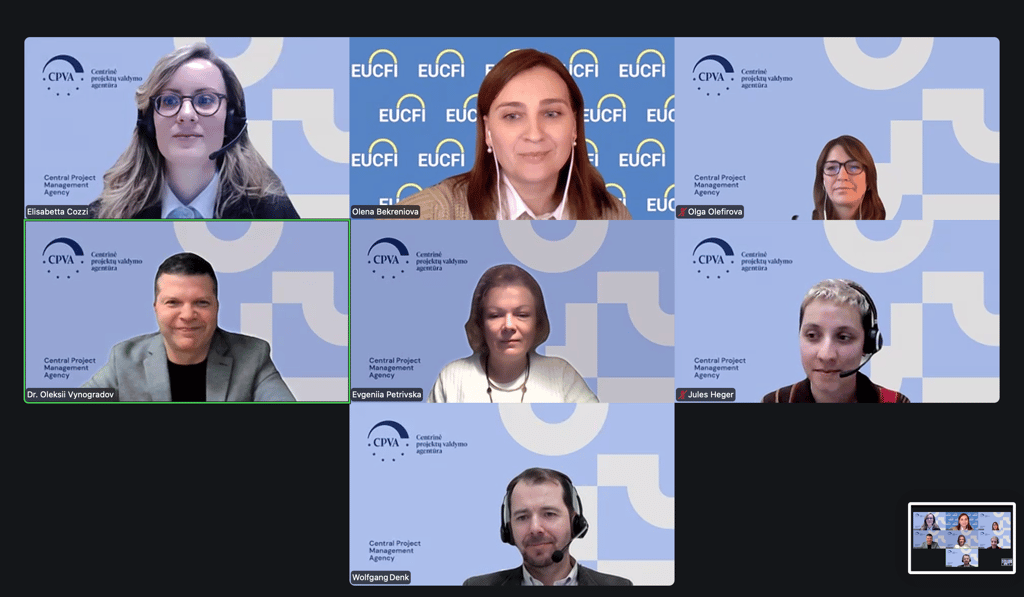
Day 2: Competence Frameworks and Youthpass
The second day shifted the focus to youth-specific competence frameworks and their connection to education, participation and employment pathways.
Representatives of the Federal Chancellery (Youth Competence Centre) presented the Austrian Youth Strategy, explaining its mission to establish coordinated youth policy across all federal ministries and to promote structural youth participation. The presentation outlined the strategy’s four fields of action – learning and employment, participation and initiative, quality of life and a spirit of cooperation, and media and information – as well as the use of Reality Checks to integrate direct feedback from young people into policy development.
The theme of professional recognition in youth work was further explored by aufZAQ, which introduced its approach to recognising competences in youth work training. The presentation highlighted the four dimensions of recognition – self-recognition, social recognition, political recognition and formal recognition – and explained how the aufZAQ competence framework functions as a quality assurance tool and as a basis for mapping non-formal qualifications to NQF and EQF levels through its role as an NQF service point.
Building on this, EUCFI presented concrete pathways from recognition to employment, demonstrating how Austrian institutions link validation of non-formal and informal learning to labour market integration. The session highlighted the complementary roles of the wba (Austrian Academy of Continuing Education) in validating competences of adult educators, the Austrian Economic Chambers (WKO) in ensuring labour-market relevance of qualifications, and the Public Employment Service (AMS) in providing guidance and employment pathways. Particular attention was given to the Professional Integration HUB, a three-month paid internship programme supporting the labour market integration of displaced Ukrainian professionals in Austria.
The final thematic input was delivered by SALTO Eastern Europe and Caucasus Resource Centre (SALTO EECA), focusing on Youthpass as a European recognition tool for learning outcomes in Erasmus+ Youth and European Solidarity Corps projects. The presentation emphasised how Youthpass supports self-reflection and visibility of competences, using the Key Competences for Lifelong Learning and the ETS Youth Worker Competence Model, and highlighted regional opportunities for strengthening recognition of non-formal learning in youth work.
The study visit concluded with final reflections and closing remarks led by EUCFI, summarising key takeaways and identifying next steps for applying Austrian experiences within Eastern Partnership contexts.
Relevance for Eastern Partnership Countries
Throughout the study visit, participants reflected on the current state of validation systems in EaP. While levels of development vary, common challenges include limited legal frameworks, low public awareness, financial barriers and insufficient links between non-formal learning and employment.
Austria’s experience offered a clear roadmap: invest in trust-based systems, embed validation in national qualification frameworks, strengthen cross-ministerial cooperation, and actively involve civil society and employers. For EaP institutions working to modernise youth policies, employment services and qualification systems, these lessons provide concrete and transferable reference points.
Building Capacity and Cooperation
The Virtual Study Visit marked an important step in strengthening regional capacity to design validation systems that support youth employability, social inclusion and resilient labour markets. It also reinforced institutional networks between Austrian stakeholders and their Eastern Partnership counterparts, laying the groundwork for future cooperation and policy dialogue.
Reflecting on Austria’s role in the exchange, Olena Bekreniova, Co-Founder of the European Centre for Freedom and Independence (EUCFI, Austria), highlighted the long-term value of validation systems:
“Austria’s experience proves that recognising skills from non-formal learning and volunteering is a long-term investment in people. Thanks to strong cooperation and strategic planning, validation becomes a tool for employment, inclusion, and resilience – and a powerful model for Eastern Partnership countries. We are proud to support this exchange.”


Adding a practitioner’s perspective, Olga Olefirova, Co-Founder of EUCFI, stressed the concrete impact of validation on young people’s life trajectories:
“Validation of competences gained through real-life experience is essential for helping young people move forward. When non-formal learning becomes visible and valued, it turns volunteering and community work into real opportunities for education, employment and personal development.”


Key Takeaways of the Virtual Study Visit
The Virtual Study Visit to Austria highlighted several key lessons for Eastern Partnership countries seeking to strengthen systems for recognising, validating and certifying skills acquired through non-formal and informal learning. First, effective validation requires clear competence standards and legal frameworks that ensure trust, transparency and comparability of qualifications across sectors and borders.
Second, the Austrian experience demonstrated the importance of cross-ministerial and cross-sector cooperation. Sustainable validation systems are built through close collaboration between education, labour and youth authorities, social partners, public employment services and civil society organisations, ensuring that recognised competences are relevant to real labour market needs.
Third, the study visit underlined the value of linking validation to employability and concrete pathways. Tools such as the National Qualifications Framework, certification systems for youth work, and initiatives like the Digital Volunteer Passport show how learning outcomes can be translated into qualifications, career guidance and employment opportunities.
Finally, participants emphasised that recognising competences gained through volunteering, community engagement and youth work is a strategic investment in people. Making non-formal learning visible and valued supports social inclusion, strengthens youth participation and contributes to more resilient and future-ready labour markets across the Eastern Partnership region.
About the Programme
The EU4Youth Phase III – Youth Employment and Entrepreneurship Programme is funded by the European Union and the Ministry of Foreign Affairs of the Republic of Lithuania and implemented by the Central Project Management Agency (CPVA). The programme supports governments and civil society organisations in Eastern Partnership countries to address youth unemployment and improve employability through evidence-based policies and practical cooperation.
As the Austrian co-organising partner, EUCFI contributed its expertise in civic engagement, youth work and cross-sector cooperation, ensuring a strong link between Austrian practice and the needs of Eastern Partnership stakeholders.
Read also:
info@eucfi.org
+43 660 9604942


The European Centre for Freedom and Independence